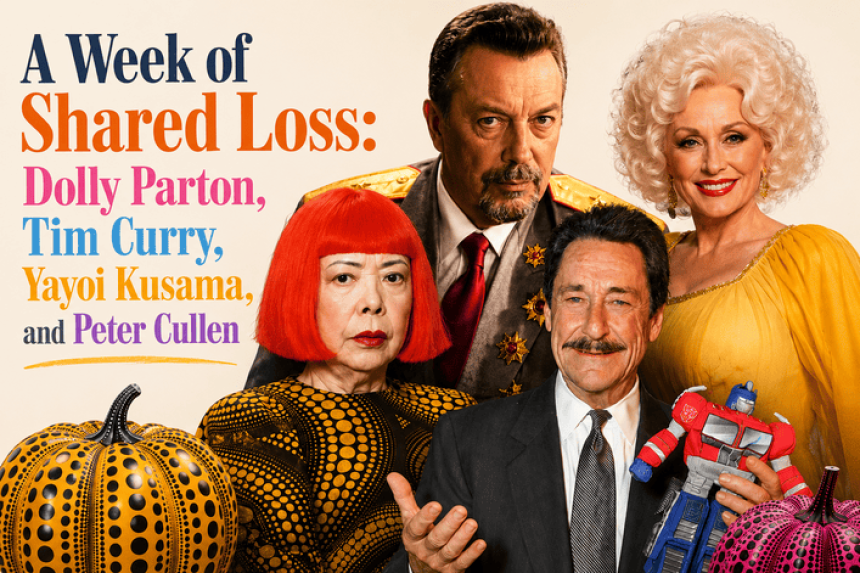

A Week of Shared Loss: Dolly Parton, Tim Curry, Yayoi Kusama, and Peter Cullen
It has been a doozy of a week. Within days, the world has lost four artists whose work reached into very different corners of public life: Dolly Parton, Tim Curry, Yayoi Kusama, and Peter Cullen.
They made radically different kinds of art. Parton gave the world songs, laughter, generosity, and a public example of compassion. Curry gave audiences danger, wit, camp, and unforgettable characters. Kusama built visual worlds of dots, mirrors, light, and infinity. Cullen, often heard rather than seen, created voices that became emotional landmarks for generations of children and adults.
What followed their deaths was not simply private mourning multiplied by millions. It was a global, networked act of remembrance. Across streets, landmarks, museums, fan communities, cinema quotes, childhood cartoons, and social feeds, people turned shared culture into tribute.
Dolly Parton’s public farewell
Dolly Parton’s death at 80 prompted the most visibly civic outpouring. In New York, the Empire State Building was illuminated in her signature pink at 9:25 p.m., a deliberate nod to “9 to 5.” The city also temporarily relabeled Fulton Street station signs as “Dolly Parton Street,” bringing her name into the daily democratic rhythm of the subway.
Across the Atlantic, Buckingham Palace’s Changing the Guard included an instrumental rendition of “9 to 5,” performed by the Band of the Coldstream Guards. It was a striking image: an American country singer’s working-woman anthem played on the forecourt of the British monarchy, evidence of how far Parton’s music, character, and influence had travelled.
But the most revealing tributes were the least official. Fans shared songs played at weddings and funerals, photographs of book parcels received through Dolly Parton’s Imagination Library, childhood memories of watching her television appearances, and stories of learning to be less ashamed of themselves because Dolly seemed so determined to meet people with warmth. Her legacy was never merely a catalogue of hits. She made kindness feel glamorous, humor feel intelligent, and ambition feel compatible with tenderness.
Tim Curry’s many lives
Tim Curry, also 80, gave audiences something gloriously different: dangerous theatricality, comic precision, a voice that could make the absurd feel monumental, and characters that became permanent fixtures of popular culture. From Dr. Frank-N-Furter in The Rocky Horror Picture Show to Pennywise in It, Wadsworth in Clue, Rooster Hannigan in Annie, and Nigel Thornberry, Curry made boldness into an art form.
Social media became a sprawling retrospective of those many lives. Susan Sarandon remembered him as “funny, sexy, original,” while speaking to his generosity. Michael McKean described a gift for bringing love and laughter to those around him. Carol Burnett recalled their time together on Annie, and Luke Evans, who later played Frank-N-Furter on stage, wrote that there would only ever be one Tim Curry.
Fans, however, did not mourn only one version of him. They remembered midnight Rocky Horror screenings, being terrified by Pennywise, the tightly wound joy of Clue, beloved animated characters, and the permission Curry’s performances gave people to be theatrical, camp, weird, sensual, frightening, or fearless. Musicians including Flea and Mike Portnoy also publicly described the formative impact of Rocky Horror.
Kusama’s infinite world
Yayoi Kusama died at 97, leaving behind a visual language recognizable almost anywhere in the world: polka dots, pumpkins, mirrored rooms, repetition, self-portraiture, light, and the destabilizing sensation of standing inside infinity. Her work transformed personal obsession and psychological struggle into environments that invited millions of people to look, photograph, reflect, and briefly lose their sense of scale.
The announcement of her death triggered tributes across the world, while cultural institutions began reshaping their programming around her legacy. Amsterdam’s Stedelijk Museum, for example, turned a planned retrospective into a posthumous celebration of her life and work.
Kusama gave contemporary art a popular visual vocabulary without making it shallow. Her Infinity Mirror Rooms became social-media landmarks, but a photograph was never the entire experience. The work asks viewers what it means to feel the self dissolve into pattern, reflection, beauty, dread, and endlessness. In the flood of images posted after her death, that tension remained: people were sharing not merely what they had seen, but the feeling of having briefly entered a world only Kusama could make.
Peter Cullen’s gentle strength
Peter Cullen, who died at 85, reminds us that a performer does not need to be physically visible to become inseparable from childhood, fandom, and memory. His voice carried authority without cruelty, warmth without sentimentality, and a depth that could make a fictional character feel like a trusted guide.
For generations of Transformers viewers, Cullen was Optimus Prime. He originated the character’s voice in the 1984 animated series and returned to it across television, games, and the live-action film franchise. Optimus Prime was more than a leader who could command “Autobots, roll out.” In Cullen’s performance, he was a figure of principled courage: calm in crisis, loyal to his community, powerful without becoming cruel.
The words associated with Cullen’s legacy, “be strong enough to be gentle,” capture why the voice mattered so much. His family echoed that idea in its statement after his death, asking fans to honor him by serving their communities and leading with compassion, integrity, and loyalty.
Yet Cullen also gave audiences Eeyore, the soft-spoken, melancholy donkey of Winnie the Pooh. He began voicing Eeyore in The New Adventures of Winnie the Pooh, which ran from 1988 to 1991, and continued to embody the character across numerous later television, film, and video projects, including The Tigger Movie, Piglet’s Big Movie, and The Book of Pooh.
Eeyore may seem, on the surface, like the opposite of Optimus Prime. One is a towering robot leader, built for battle; the other is an often gloomy donkey who assumes the worst and moves slowly through the Hundred Acre Wood. But both characters carried a similar emotional generosity in Cullen’s hands.
Eeyore gave children and adults something quietly radical: a character allowed to be sad, pessimistic, tired, and still fully loved by his friends. He was never asked to become relentlessly cheerful before he could belong. His gloom was often funny, but it was not treated as a reason to exclude him. Cullen’s low, tenderly weary delivery made Eeyore feel less like a joke about sadness and more like a companion for anyone who had ever struggled to keep up with the world’s demand for optimism.
That is an extraordinary gift to have made through a voice. Cullen gave many people two models of emotional life: Optimus Prime, who taught that real strength protects rather than dominates, and Eeyore, who suggested that being low does not make someone less worthy of friendship. His work offered reassurance at both ends of the emotional spectrum.
Mourning in public
t is easy, and often fair, to be cynical about grief online. Platforms can reward speed, spectacle, repetition, and performative emotion. Yet this week’s losses show another possibility. Social media allows a person’s cultural afterlife to be assembled in public by the people who received it.
A fan’s memory of discovering Rocky Horror in a small-town cinema can sit beside an actor’s tribute. A photograph from a Kusama exhibition in Tokyo can appear alongside a Dolly Parton lyric in Tennessee, a pink Empire State Building in New York, or a post from someone replaying Cullen’s Optimus Prime speeches and recalling Eeyore’s patient sadness.
The result is not one official eulogy. It is a living archive of what art did in people’s actual lives.
For all its controversy, social media can serve as a way to remember: not perfectly, not quietly, and not without noise, but collectively. This week, as the world mourns Dolly Parton, Tim Curry, Yayoi Kusama, and Peter Cullen, it has also revealed the scale of what artists give us.
Parton offered resilience and generosity. Curry made theatricality, strangeness, and fearless performance feel liberating. Kusama made infinity briefly visible. Cullen gave millions a voice that sounded like courage, as well as another that made room for sadness.
In the days after artists are gone, people do what audiences have always done. They replay the songs, revisit the scenes, share the photographs, quote the lines, and tell one another where they first encountered the work. Now those acts take place in public and across borders. A pink skyscraper, guards playing “9 to 5” outside Buckingham Palace, a Rocky Horror quote from a stranger, an image inside an Infinity Mirror Room, “Autobots, roll out,” or a quiet remembrance of Eeyore can each become a small memorial. Together, they form a living record of love, influence, and cultural memory.
About the Author
Nikki Lopez is a seasoned professional with over a decade of experience in the startup world, specializing in leveraging creative content and community building to empower content creators. Known for a strategic approach and a deep understanding of audience needs, Nikki has a proven track record of leading the development of engaging content strategies and guiding the growth of thriving communities. Her leadership focuses on fostering meaningful interactions and impactful journeys for both creators and their audiences.