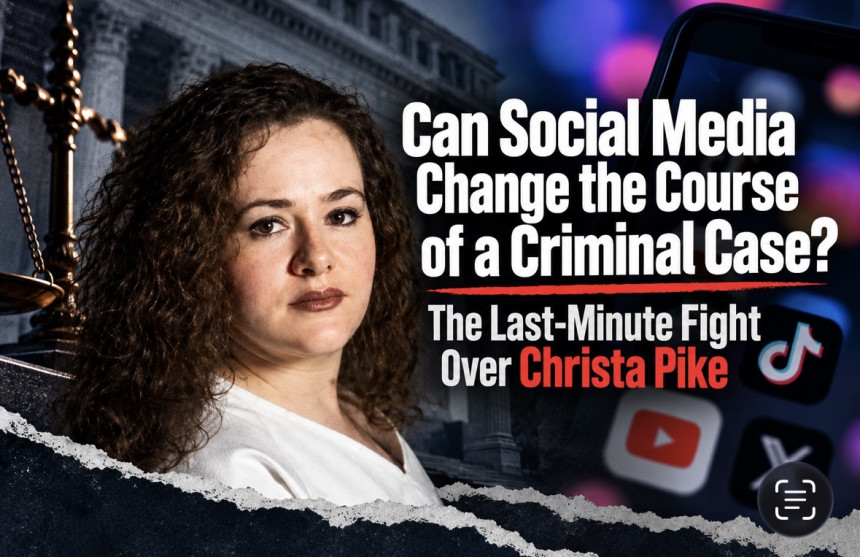

Can Social Media Change the Course of a Criminal Case?
The Last-Minute Fight Over Christa Pike
At 10 a.m. on September 30, 2026, Christa Pike was scheduled to be executed by the state of Tennessee.
About two hours before that was supposed to happen, everything changed.
The U.S. Court of Appeals for the Sixth Circuit temporarily stayed Pike’s execution, saying the court needed more time to adequately consider the legal issues raised in her case. Tennessee immediately asked the U.S. Supreme Court to lift the stay. (AP News)
For anyone who has spent time on true-crime social media recently, Pike’s name is probably familiar. Her case has exploded online as creators, advocates, attorneys, and organizations have asked the same question: Was Christa Pike treated fairly?
That question is considerably more complicated than a TikTok can make it seem.
And the events surrounding Pike’s scheduled execution offer another question worth asking: When thousands of people start talking about the same case online, can that attention actually make a difference?
Who Is Christa Pike?
In January 1995, 18-year-old Christa Pike participated in the brutal murder of 19-year-old Colleen Slemmer in Knoxville, Tennessee.
Pike, her boyfriend Tadaryl Shipp, and another teenager, Shadolla Peterson, lured Slemmer to an isolated area near the University of Tennessee agricultural campus. Slemmer was beaten, cut, and killed. Pike later admitted her involvement in the murder and was convicted and sentenced to death in 1996. (The Washington Post)
Nothing about the renewed attention surrounding Pike’s case changes what happened to Colleen Slemmer.
That distinction is important because much of the current conversation is not about Pike’s guilt. Instead, it centers on what happened during sentencing and whether the jury that sentenced an 18-year-old Pike to death was given enough information about the person sitting in front of them.
Why Are People Asking Whether Pike Was Treated Fairly?
Pike’s attorneys and advocates have argued that the jury never heard the full extent of her childhood.
According to her clemency petition, Pike experienced severe neglect, physical abuse, and repeated sexual abuse beginning when she was a toddler. Her attorneys have also presented evidence of neurological impairment, mental illness, and PTSD. They argue that Pike’s original defense attorneys failed to adequately present this history as mitigating evidence during the sentencing phase of her trial. (The Washington Post)
That does not mean this information excuses Slemmer’s murder. In fact, organizations advocating on Pike’s behalf have explicitly acknowledged the seriousness of her crime while arguing that the circumstances of her childhood, mental health, and age should have been considered more fully when determining her sentence. (The Washington Post)
Her age has become another major point of discussion.
Pike was 18 when Slemmer was murdered. According to Pike’s clemency petition, eight people in Tennessee’s modern death-penalty era received death sentences for crimes committed when they were 18. The sentences of the other seven were eventually vacated. (The Washington Post)
There were also significant differences in the sentences received by the three teenagers involved in Slemmer’s murder. Shipp, who was 17 and therefore could not receive a death sentence, received life in prison. Peterson testified against Pike and Shipp and received probation. Pike was the only one sentenced to death. (The Washington Post)
Those facts have fueled the question spreading online: Was Pike’s sentence fair?
The courts have repeatedly upheld her conviction and sentence, and the Tennessee Supreme Court concluded in 2025 that there was no legal reason preventing the execution from proceeding. On September 28, Governor Bill Lee also denied Pike’s request for clemency. (Tennessee Courts)
But that wasn’t the end of the case.
Then, Minutes Before Her Execution, a Court Stepped In
Pike was scheduled to die by lethal injection at 10 a.m. Central Time on September 30.
At approximately 8:17 a.m., the Sixth Circuit issued a temporary stay.
The court explained that the “interests of justice” required additional time to properly analyze the arguments before it. Importantly, the decision did not overturn Pike’s conviction or her death sentence. It temporarily stopped the execution while the court considered the legal questions before it. Tennessee quickly asked the U.S. Supreme Court to vacate the stay. (WZTV)
That brings us to social media.
Did Social Media Stop Christa Pike’s Execution?
There is currently no evidence that it did.
The Sixth Circuit didn’t stay Pike’s execution because a video went viral, a petition collected thousands of signatures, or enough people posted about her case. The court was responding to legal arguments brought by Pike’s attorneys.
But that doesn’t mean the online campaign surrounding Pike accomplished nothing.
The “Mercy for Christa” campaign actively encouraged supporters to share Pike’s story on social media and contact Governor Lee. Amnesty International similarly encouraged supporters not only to write to the governor but to post about the case online. (Mercy for Christa)
By September 29, an online petition asking Lee to stop Pike’s execution had accumulated more than 35,000 signatures. The petition specifically encouraged signers to share it widely on social media. (Action Network -)
More than 100 organizations and experts also called on the governor to commute Pike’s sentence, while the case received increasing national media attention as the execution approached. (The Washington Post)
Governor Lee ultimately denied clemency, so the social media campaign did not accomplish its primary goal through the governor’s office.
But consider what it did accomplish.
Thousands of people who may never have heard Christa Pike’s name learned about her case. They learned about the questions surrounding her original sentencing. They read about the mitigating evidence her attorneys say the jury never heard. They signed petitions. They contacted elected officials. Journalists revisited a murder committed more than three decades ago. Organizations joined the conversation.
And people kept talking.
For Creators, That’s the Part Worth Paying Attention To
Social media gets plenty of criticism, often deservedly so. Misinformation can spread just as quickly as legitimate information, and true-crime creators in particular have an enormous responsibility to remember that the people in these stories are not characters.
Colleen Slemmer was a real 19-year-old woman. Her mother, May Martinez, has spent more than three decades living with her daughter’s murder and has publicly supported carrying out Pike’s sentence. Her voice belongs in this story too. (AP News)
But the Christa Pike case also demonstrates something creators sometimes underestimate: your platform gives you a voice.
You may not have millions of followers. You may not have hundreds of thousands. You might have a few hundred people who regularly watch your videos or read your posts.
Those people have people too.
One person posts a story. Someone else shares it. Another person researches it. A journalist notices growing interest. An organization provides resources. Thousands of people sign a petition. Suddenly, an issue that previously existed outside most people’s awareness has an audience.
That doesn’t mean a viral video can override a court ruling, nor should creators take credit for legal outcomes they did not cause. In Pike’s case, today’s stay resulted from litigation, not social-media engagement.
But social media can determine what people know about.
And before anyone can care about an issue, they first have to know it exists.
Your Voice Doesn’t Have to Be the Loudest One
There is a lesson here that reaches far beyond Christa Pike.
If there is a cause you genuinely care about, talk about it.
Research it first. Find reliable sources. Link to primary documents when they’re available. Be honest about what you know and what you don’t. Don’t manipulate facts because a more dramatic version makes a better video. And when you’re discussing real victims, never allow your desire for engagement to overshadow their humanity.
Then use your platform.
A creator doesn’t need to single-handedly change the world for their voice to matter. Sometimes the contribution is much smaller: getting one more person to read about something they otherwise would never have encountered.
That person may tell someone else.
Thirty-five thousand signatures don’t appear out of nowhere.
Whatever ultimately happens next in Christa Pike’s case will be determined through the legal process—not by TikTok, Instagram, or a petition.
But the enormous public conversation happening alongside that process is a reminder of what social media can do when people decide an issue deserves attention.
Creators spend a lot of time worrying about reach.
Sometimes, it’s worth remembering what that reach can actually be used for.
About the Author
Ashley is a military wife and mother, who can often be found listening to an audiobook while driving the mom taxi, desperate to cling to sanity through the joy of escapism. Her love of reading inspired her return to school, and she is currently finishing her bachelor’s degree in creative writing at Southern New Hampshire University. Being a mother does not mean you have to give up your dreams, and her story is still being written.