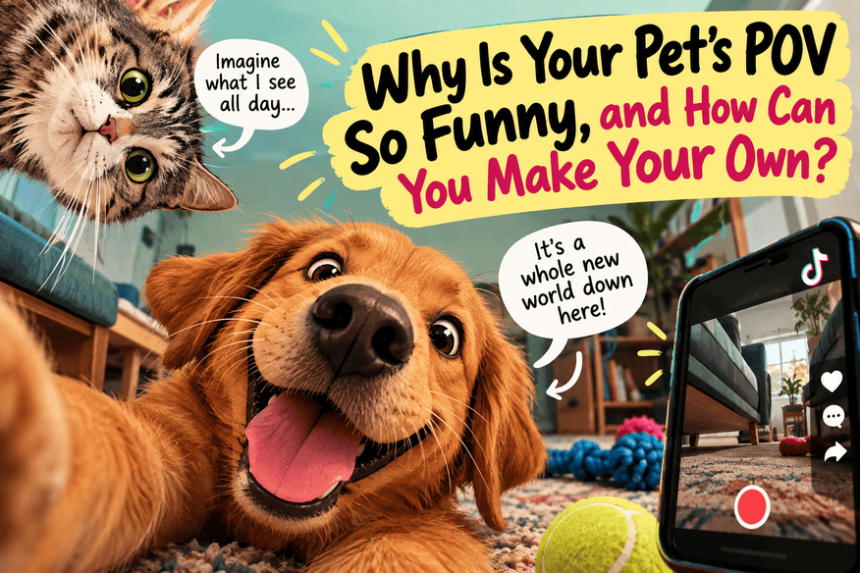

Why Are Animal Voiceovers Popular on TikTok?
A dog staring at an empty bowl is cute. A dog staring at an empty bowl while announcing, “I was told this was an all-inclusive arrangement,” has a character, a grievance, and the beginnings of a comedy career.
That is the appeal of animal voiceovers. The footage gives you the expression, but clever writing gives it a story. Add the right delivery, and an ordinary pet video becomes a miniature comedy scene without an elaborate shoot.
While TikTok offers plenty of examples, the internet was giving animals imaginary personalities long before it became a short-form video habit. Randall’s honey badger narration broke through in January 2011, and Ze Frank’s Sad Cat Diary was circulating widely in May 2013. Both demonstrated how a strong script and a distinctive performance could completely change the way we watched animal footage.
Today, you can still perform the voice yourself. But tools that convert text into speech also let you turn a written script into narration, making the format accessible even if character voices are not your thing. TikTok and CapCut both offer that option.support.
The opportunity is not simply to jump on a trend. It is to put your writing skills to work and let your pet become your most demanding fictional collaborator.
The viral videos that came first
Animal voiceovers are not a new trick. Before the talking pets on TikTok, videos like Randall’s honey badger narration and Ze Frank’s Sad Cat Diary showed how clever writing and a distinctive voice could turn animal footage into comedy.”
The honey badger’s attitude
The Crazy Nastyass Honey Badger, narrated by Randall, became a viral sensation in January 2011. It paired existing wildlife footage with irreverent commentary, turning a nature segment into a comedy built around the animal’s apparent indifference to danger.
Strictly speaking, this was not a video told from the honey badger’s perspective. Randall was commenting on its behavior rather than speaking as the animal. But it belongs in the same creative family: footage transformed through writing, interpretation, and vocal personality.
The honey badger did not need to behave differently for the joke to work. The narration changed the story we were watching. Randall explained that he found the original narration dull and wanted to “spice this thing up.
That is a useful way to think about your own footage. You may already have the visual material. What you need is an angle.
The cat’s private grievances
Ze Frank’s Sad Cat Diary, which attracted coverage in May 2013, took the more direct animal POV approach. Its fictional diary entries presented cats as sorrowful creatures reflecting on the supposedly miserable events of their domestic lives.
The humor came from treating minor inconveniences as profound suffering. A comfortable household pet became the tragic protagonist of its own memoir.
It is a strong writing lesson: choose a point of view and commit to it. Once the cat sees itself as misunderstood and oppressed, ordinary household moments become material.
Both videos relied on distinctive human narration. That does not mean creators back then needed a conventionally “good” voice. They needed a performance that suited the writing. Now, generated voices offer another route. You can focus on the script without having to perform every line yourself, although choosing the voice and shaping the timing still matter.ibtimes+2
The technology can supply the speech. It cannot make the observation for you.
The writing makes it funny
A funny voice gets your attention. A well-written line gives it somewhere to go.
“I’m hungry” describes a dog looking at an empty bowl. “I’ve contacted management, and frankly, the response has been disappointing” gives that dog a personality.
The joke sits in the gap between what the animal is doing and how your character interprets it. A closed door becomes a betrayal. A bath becomes an outrage. A delivery becomes a parcel that was clearly intended for the dog, regardless of the name on the label.
For a creator, this is an opportunity to practise dialogue, characterization, and comic timing in a compact format. You already have the visual setup. Your job is to find the unexpected thought.
Imagine a cat knocking a pen off your desk:
“I’ve reviewed your manuscript.”
The pen hits the floor.
“We’ll be going in a different direction.”
That original example has a character, an action, and a payoff. The footage helps finish the joke, so the script does not have to explain everything.
This is also how you make the trend fit your existing content rather than copying another account. A book creator might give a cat the personality of a merciless editor. A food creator could turn a dog into a restaurant critic. An artist might discover that the household rabbit has strong opinions about composition.
Your pet could be the household manager, with concerns about meal service and your general performance. Or the dramatic protagonist, for whom every inconvenience is a major plot development. Perhaps it is the reluctant coworker who wants to know why this meeting could not have been an email.
The more specific the character, the more you have to write about. A confident amateur with no qualifications but plenty of advice is a different character from a cultural critic who considers your taste in books a personal disappointment.
You do not need to make every animal sound like an internet baby. A quiet, businesslike complaint might suit your writing much better.
You do not need to narrate every second, either. Sometimes the best thing you can write is a short line followed by enough silence for the animal’s expression to answer.
Tools without heavy production
One of the attractive things about this format is that the production can stay straightforward while the writing does the heavy lifting.
You can work with an ordinary clip, write a short scene, and either record it yourself or generate the narration. TikTok supports voiceovers and text-to-speech features. CapCut offers recording, generated speech, and audio editing controls
TikTok voiceover
TikTok lets you record narration within its editing workflow and apply optional voice effects. This gives you a way to perform the character yourself and match the delivery to the action.
Your own voice leaves room for an offended pause, a muttered complaint, or an excessively cheerful response that clearly means the opposite.
TikTok generated speech
TikTok can read text added to a video aloud. This gives you an alternative when you would rather write the character than perform it.
Choose a delivery that suits the scene rather than assuming the most exaggerated voice will be the funniest.
CapCut recording and narration
CapCut lets you record or import narration and adjust audio settings such as volume and speed. Its generated speech tool also lets you enter a script, select a voice, create the narration, and add it to your project.
Think of it as separating two creative jobs. You can write the character without also having to become its voice actor.
Captions
TikTok can automatically transcribe speech and lets you edit the resulting captions. Check them carefully so a missed word does not change the meaning or spoil the punchline.s
There is still editing to do with any of these approaches. You need to choose a suitable voice, check how it reads the line, and make the words land against the footage. But you can concentrate your effort on the part you enjoy most: finding something funny to say.
TikTok accounts to explore
The earlier viral classics show the roots of the format. These TikTok accounts offer examples of how creators have developed it into recurring characters and short comedy scenes.
TikTok accounts to explore
The earlier viral classics show the roots of the format. These TikTok accounts offer examples of how creators have developed it into recurring characters and short comedy scenes.
RxCKSTxR
RxCKSTxR on TikTok, under the handle @therxckstxr, features comedy voiceovers involving dogs, cats, and other animals. His official website identifies animal voiceover comedy as the center of his work, and his TikTok includes imagined dialogue and reactions.therxckstxr+2
Use the account as a prompt to look for conversations inside footage. One animal approaches; another turns away. What might the first have said? What response would make the movement funny?
That exercise shifts you from describing a clip to writing a scene.
Dusty Dubs
Dusty Dubs on TikTok, under the handle @dustymdouglas, includes talking animal clips and voiceover compilations. A June 2026 example showed 1.4 million likes when indexed, illustrating the substantial audience this kind of comedy can attract.
As you watch, think about economy. How little explanation does a viewer need to understand the premise? Could your own script establish a character more quickly or end one line earlier?
Tatum Talks
Tatum Talks on TikTok, under the handle @hi.this.is.tatum, is a notable example of building a recognizable animal character through a consistent voice. Owner Charles Lever supplied the performance, and the account grew to millions of followers.thesprucepets+1
There is a recent, sad update to acknowledge: WABI reported in early October 2026 that Tatum had died. His owners said they planned to keep his social accounts active and preserve his memory. The account remains a much-loved body of work to explore, rather than an ongoing series of new adventures with Tatum.wabi
For creators, it offers a reminder that consistency matters. A character with an established outlook gives you a starting point for each new script.
Make your pet’s POV
For your first attempt, keep the brief focused: one clip, one character, one joke.
- Choose a clear moment. A stare, a head turn, a refusal, or an unexpected movement gives you something to write around. Use footage you own or have permission to use.
- Decide who is speaking. Give the animal an attitude or role before choosing its voice.
- Write the thought, not the description. “I’m sitting on your keyboard” tells us what we can see. “Your availability has been updated” gives us an interpretation.
- Draft a few alternatives. Try a formal complaint, a dramatic accusation, and an unexpectedly sweet response. Pick the one that fits the footage.
- Choose the delivery. Record it yourself or test a generated voice. Listen for whether the performance supports the joke.
- Match the words to the action. Put the objection on the retreat, the accusation on the stare, or the punchline just after the head turn.
- Add and check captions. TikTok lets you edit automatically generated captions, so correct anything that changes the meaning or spoils the line.support.tiktok
- Cut what you do not need. Leave room for the animal’s expression to do some of the storytelling.
Keep the comedy in the writing and editing, not in creating a stressful situation for the animal. An ordinary moment is enough.
You also do not have to turn your entire account into a pet comedy channel. This can be an occasional way to use your writing, show your humor, or put a different spin on the content you already make.
The honey badger had attitude. The sad cats had grievances. Your pet probably has something to say about your management style.
Now you can write the complaint, even if you would rather leave the voice acting to a tool.