

Why Writing for Free or Cheap Can Be a Smart Start and How to Raise Your Rates From There?
Every writer wants to be paid well for their work. You should be. Writing takes time, skill, research, revision, judgment, and emotional energy, and none of that is worthless.
But at the beginning of a writing career, the question is not always, “What is my ideal rate?” Sometimes the more useful question is, “What will help me build enough proof to charge that rate?”
For many new writers, taking a few free or low-paid projects can be a practical first step. The key word is strategic. You are not working for free because your writing has no value. You are making a short-term investment in a portfolio, relationships, experience, and evidence that you can deliver results.
The goal is not to stay cheap. The goal is to build the validation that lets you confidently, and successfully, charge what you need
Your Portfolio Is Your Proof
Clients do not only hire writers because they like the idea of a writer. They hire people who can show that they understand an audience, meet a deadline, follow a brief, write clearly, and create work with a purpose.
Early on, you may not have enough published clips to prove those things. That is where selective free or inexpensive work can help.
A strong portfolio tells potential clients:
- You can write in a specific style or niche.
- You understand how to shape a story, article, caption, newsletter, script, or web page.
- You can work with feedback and revise professionally.
- You can produce finished work, not just ideas.
- Other people have trusted you with a real assignment.
Think of those first projects as portfolio-building assignments, not permanent business models.
For example, a writer who wants to specialize in wellness content might write a few deeply researched articles for a small publication, nonprofit, or local business at a reduced rate. In exchange, they should aim to receive a byline, permission to use the clip in their portfolio, a testimonial, and a clear understanding of what kind of work they enjoy doing.
That one low-paid project can become proof for the next, better-paid client.
Work Cheap With Boundaries
There is a major difference between choosing a limited, low-paid opportunity and allowing people to repeatedly exploit your labor.
Free work can make sense when it gives you something valuable that you genuinely need at this stage: a credible byline, a strong sample, a testimonial, an introduction to an editor, experience in a new format, or access to a niche you want to enter.
It makes less sense when someone wants substantial commercial work but offers only “exposure,” vague promises, or endless future possibilities.
Before accepting unpaid or cheap work, ask yourself:
- Will I be able to publish this in my portfolio?
- Does this project match the kind of work I want to be hired for later?
- Will I get a byline, testimonial, referral, or measurable result?
- Is the scope small and clearly defined?
- Would I still feel good about this decision a month from now?
- Am I setting a deadline for moving beyond this rate?
A free guest post that helps you enter your ideal niche may be useful. Writing weekly content for a profitable company with no pay, no credit, and no clear benefit probably is not.
Put limits around your early-stage generosity. You might decide to do three portfolio projects, work at an introductory rate for your first five clients, or offer a reduced price only for a clearly defined package. Once you have enough proof, reassess.
Raise Your Prices as Your Evidence Grows
You do not need to wait until you feel completely confident to increase your rate. Most writers never reach a magical moment where charging more suddenly feels easy.
Instead, raise your prices when your body of evidence grows.
That evidence can include:
- A stronger portfolio with relevant clips.
- Repeat clients.
- Positive testimonials.
- Better writing speed and a more efficient process.
- A clearer specialty.
- Stronger client communication and project management.
- Results your work helped create, such as traffic, subscriptions, leads, sales, or engagement.
- Increased demand for your time.
Start by creating a simple baseline rate that reflects the time a project truly takes. Include research, outlining, interviews, drafting, editing, client communication, revisions, administrative work, and taxes, not only the time spent typing.
Then increase gradually. You do not have to double your prices overnight.
A simple approach could look like this:
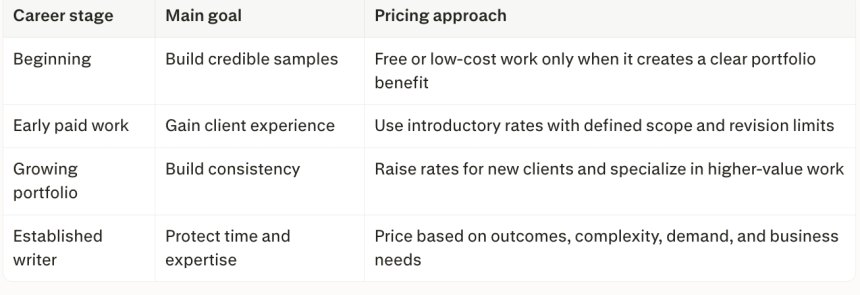
You can also raise prices first for new clients while honoring an existing agreement with current ones. This makes the transition feel less intimidating.
A straightforward message works well: “My rates are increasing for new projects starting next month to reflect my experience, process, and current workload.” You do not need to apologize for this. You are running a business, and your pricing should evolve as your value and capacity evolve.
Success Does Not Always Look Like Fame
One of the most damaging myths about writing is that success only counts if you become a bestselling author, a nationally recognized journalist, a major columnist, or a writer with a huge online following.
Those things may happen for some people. But they are not the only version of a successful writing life.
A successful writer may be someone who earns steady income from content marketing, copywriting, editing, grant writing, newsletters, technical writing, ghostwriting, journalism, teaching, or freelance features. They may write books while holding another job. They may work part-time, freelance between contracts, teach workshops, manage social media, edit manuscripts, or work in an entirely separate field.
Even writers who eventually “make it big” often spend years doing other work while developing their craft and building their careers. There is no shame in that. A day job can provide stability, health insurance, structure, material for your writing, and the freedom to be selective about the work you accept.
Your writing career does not have to look impressive from the outside to be real.
It can be built quietly: one clip, one client, one pitch, one revision, one rate increase at a time.
Build the Career You Actually Need
Working for free or cheap at the very beginning is not a requirement for every writer, and it should never become an expectation that follows you forever. But when chosen carefully, it can help you create the portfolio that validates your skills in a competitive market.
Use early projects to gather proof. Turn proof into paid work. Turn paid work into stronger samples, better clients, and higher rates.
Most importantly, remember that writing success is not reserved for a small group of famous names. A sustainable writing career can be built through skill, consistency, relationships, strategy, and a willingness to keep adjusting your prices as your experience grows.
Start where you are. Be intentional about what you accept. And make sure every early opportunity is helping you get closer to the rate ,and writing life, you actually want.
About the Author
Nikki Lopez is a seasoned professional with over a decade of experience in the startup world, specializing in leveraging creative content and community building to empower content creators. Known for a strategic approach and a deep understanding of audience needs, Nikki has a proven track record of leading the development of engaging content strategies and guiding the growth of thriving communities. Her leadership focuses on fostering meaningful interactions and impactful journeys for both creators and their audiences.