
When the Museum Dreams: Refik Anadol, AI Pioneers, and the Fight to Protect Artists
The recent 60 Minutes spotlight on Refik Anadol didn’t just ask, “Is AI art?", it asked how far museums, collectors, and courts are willing to go to embrace a medium built out of code and other people’s images. To answer that, it helps to look at what Anadol actually makes, who his peers are, and how the law is beginning to draw lines around intellectual property
Refik Anadol’s Machines That “Hallucinate” Art and Space
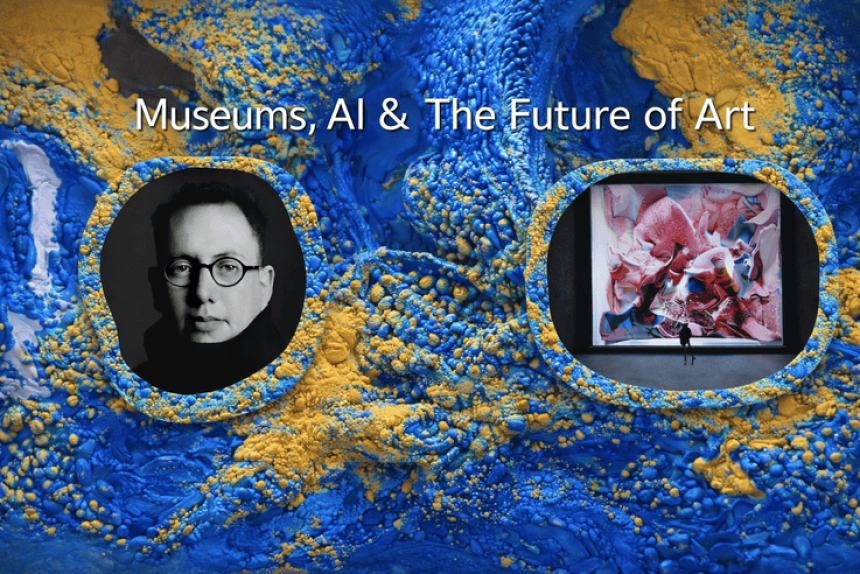
Anadol’s best-known work, Unsupervised, turned the Museum of Modern Art’s collection into raw material for an endlessly shifting “dream” on a massive LED wall in the museum’s lobby. He trained a custom model on data representing over 200 years of MoMA artworks, then used a “latent space browser” and fluid dynamics algorithms to generate a continuous flow of abstract forms that respond in real time to light, sound, and movement in the space.
This is AI as medium in a very literal sense: the “paint” is metadata from MoMA’s archive, the “brush” is a generative model, and the final image is never fixed but constantly recomposed. Visitors don’t stand in front of a single static canvas; they stand inside a machine’s evolving interpretation of art history.
In his Machine Memoirs: Space series, Anadol pushes the idea even further by training models on millions of publicly available NASA images, from the Hubble Space Telescope, the International Space Station, and the Mars Reconnaissance Orbiter. He and his studio classify and process this data so that machine-learning systems can weave it into “data paintings,” animated tunnels, and sculptural forms that speculate visually on humanity’s exploration of the cosmos.
Here, the data is drawn from scientific archives rather than other artists’ styles, which makes the ethical terrain very different from tools that quietly scrape living artists’ work. Anadol’s practice shows the most compelling version of AI art: clear authorship, original concepts, and transparent use of institutional or scientific datasets.
Other AI Pioneers: Beyond Screensavers and Hype
Anadol isn’t alone in treating AI as a serious artistic material. A small but influential group of artists has been building this space for years:
Mario Klingemann
A German artist who works with neural networks, code, and algorithms to probe how machines “see” us and how aesthetics emerge from data. His piece Memories of Passersby I used generative models to create an endless stream of shifting portraits, and became one of the first AI artworks to sell at a major auction house.
Sougwen Chung
An artist who draws alongside robotic arms trained on her own gestures, turning human–machine collaboration into a live performance and a studio practice. Instead of asking a model to “imitate” others, she uses AI and robotics to extend her own body, blurring the line between solo authorship and co-creation.
These artists share a few things with Anadol: they design processes, build or tune their own systems, and make the ethics of data and collaboration part of the work’s content. That’s very different from typing a prompt that says “paint in the style of X” into a commercial tool and exporting whatever comes out.
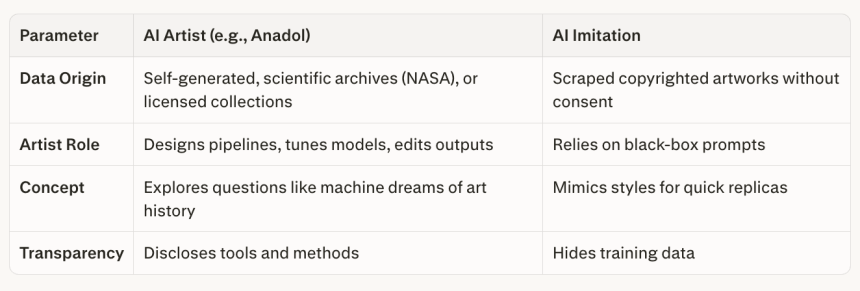
AI Artist vs. AI Imitation: Drawing the Line
Using Anadol and these pioneers as reference points, you can sketch out parameters that separate “AI as art medium” from “AI as imitation engine”:
Why This Debate Helps Human Artists
This friction sharpens what makes human art irreplaceable: embodied experience and singular vision over pattern-matching. It also spotlights hybrid possibilities, painters sketching with AI aids, performers with robots, while exposing risks like cheap AI substitutes undercutting commissions.
Legal Wins, Practical Tools, and Guardrails for All
Artists aren’t passive here. The 2023 class-action Andersen v. Stability AI lawsuit, filed by Sarah Andersen, Kelly McKernan, and Karla Ortiz, saw key copyright claims advance in 2024, with 2026 litigation now targeting commercial outputs and forcing more training data disclosure. This backs everyday protections artists use today:
- Block crawlers with robots.txt and poison images via Nightshade or Glaze, which corrupt training data invisibly.
- Opt out via HaveIBeenTrained.com or company lists from Midjourney and Stability AI.
- Embed copyright metadata, use forensic watermarks, and gate high-res files behind logins.
- Add "No AI Training" clauses to contracts and register copyrights preemptively.
Layering these reduces risks while legitimizing ethical AI like Anadol’s MoMA and NASA works. The future holds transparent innovation, machines dreaming from public data, paired with non-negotiable rights, ensuring no one's memories fuel someone else's profit without consent.
Cited sources
CBS News / 60 Minutes segments on Anadol
MoMA Unsupervised; Anadol Studio (Unsupervised, Machine Memoirs)
NASA collaborations; Pioneers Klingemann/Chung
Andersen v. Stability AI updates
About the Author
Nikki Lopez is a seasoned professional with over a decade of experience in the startup world, specializing in leveraging creative content and community building to empower content creators. Known for a strategic approach and a deep understanding of audience needs, Nikki has a proven track record of leading the development of engaging content strategies and guiding the growth of thriving communities. Her leadership focuses on fostering meaningful interactions and impactful journeys for both creators and their audiences.