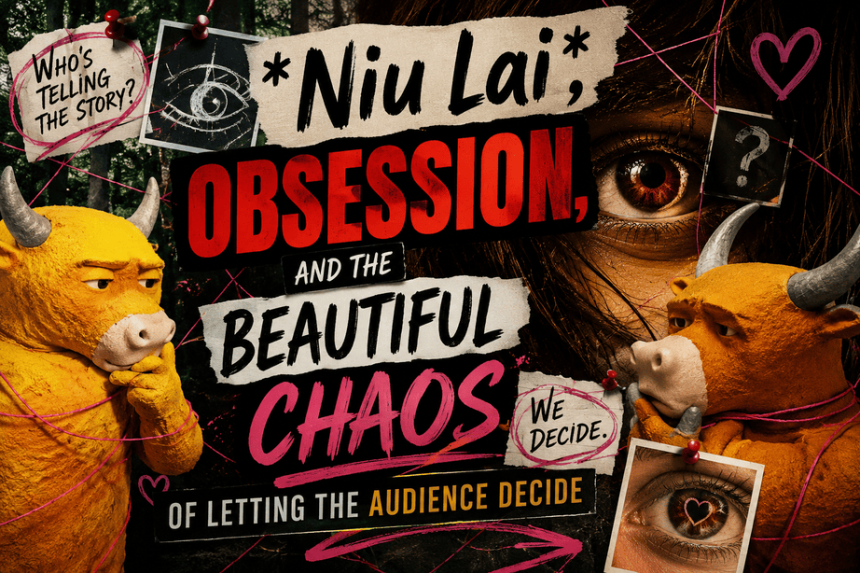

Niu Lai, Obsession, and the Beautiful Chaos of Letting the Audience Decide
Some movies arrive with a billion-dollar marketing campaign, celebrity interviews, prestige posters, and a trailer that makes every sentence sound like it was whispered from the edge of a cliff.
And then there is Niu Lai.
The Chinese animated movie, about a young calf navigating a strange, dreamlike journey, initially looked destined to become one more tiny title swallowed by the summer-release machine. Its animation was widely mocked online as crude, uncanny, and, depending on who you asked, the visual equivalent of finding a forgotten USB drive in a drawer labeled “DO NOT OPEN.”
But then something extraordinary happened: people began sharing it, memeing it, debating it, and buying tickets to see what the fuss was about.
The movie was reportedly made over roughly five years by a two-person team: director Xin Yumeng and his mother, Sun Lifan. It began with little commercial momentum, then became a viral box-office story after online attention transformed its perceived flaws into a must-see event.
And in the process, it reportedly dethroned Obsession as the most profitable film ever relative to its production budget. Niu Lai is said to have grossed more than $4 million on a budget estimated around $200—a return so absurd it sounds less like a business calculation and more like a typo that escaped into the universe.
You do not get to decide what people love.
You only get to make the thing.
The Internet Loves a Plot Twist
In the normal creator fantasy, success is neat. You work hard, improve your craft, launch your project, and the audience arrives carrying flowers, praise, and perhaps a modest brand partnership.
Reality is more like this:
- You make something you believe in.
- Nobody notices.
- A stranger calls it “the weirdest thing I have ever seen.”
- Thousands of people show up.
- You are somehow a cultural moment.
That is not a joke; it is practically the Niu Lai rollout strategy.
The film initially earned so little that it seemed likely to disappear almost immediately. Then online discussion about its rough visual style turned it into a curiosity. People did not necessarily show up because they expected a polished masterpiece. They showed up because they felt they needed to witness it for themselves.
Creators often treat negative reactions as a death sentence. Sometimes they are. But sometimes a strong reaction—confusion, disbelief, fascination, even affectionate mockery—is evidence that your work has done something much harder than being “good.”
It has made people feel something.
And in an online world packed with content engineered to be acceptable, forgettable, and optimized to within an inch of its life, being memorable is not nothing.
Lesson One: “Perfect” Is Not a Marketing Strategy
here is a particular kind of creative procrastination disguised as high standards.
“I can’t post this yet. The edit needs work.”
“I need better lighting.”
“The branding is not cohesive.”
“The font does not yet communicate my complicated inner world.”
Obviously, quality matters. Nobody is suggesting you publish a blog post that begins with “Hello my beautiful audience,” ends with “subscribe for fancier thoughts,” and contains 14 spelling errors in between.
But Niu Lai is a useful antidote to perfection paralysis. The film’s roughness was not hidden. It was visible enough to become part of the conversation. Its handmade, unconventional feel also gave audiences something to rally around, especially as viewers framed it as a contrast to mass-produced or AI-generated content
For creators, the point is not: “Make bad work on purpose.”
Please do not turn that into a content strategy.
The point is: do not assume technical polish is the only route to connection. A project can be strange, imperfect, niche, homemade, emotionally earnest, or aesthetically offbeat, and still find the people who love it.
Sometimes the tiny flaw is not the thing that ruins the work.
Sometimes it is the thing people remember.
Lesson Two: The Audience Finishes the Story
Creators make the initial object. Audiences make the cultural event.
A film is a film until viewers turn scenes into memes. A song is a song until TikTok gives it a breakup montage, a dance trend, and three thousand people crying in their cars. A book is a book until readers begin annotating passages, inventing theories, arguing over side characters, and assigning everyone in the cast a zodiac sign.
Niu Lai became larger than its makers’ original release plan because audiences gave it a second life through conversation. Social media users transformed the movie’s oddness into a shared joke, a curiosity, and eventually a communal experience.
That is an important creative lesson: you cannot fully control the meaning of your work after you publish it.
You can guide it. You can explain it. You can build context around it. But once it is out in the world, people bring their own humor, memories, references, and emotional baggage to it. They might love the exact detail you nearly cut. They might misunderstand your point and somehow make it more interesting. They might turn your serious labor of love into a meme.
This is not always comfortable. But it is how culture works.
The audience is not merely receiving the work. They are participating in it.
Lesson Three: “Nobody Wants This” Is Usually a Guess
Before Niu Lai, Obsession held the title for the most profitable movie ever relative to budget. Its success was its own kind of useful creative fable: a lower-budget horror film taking a big swing in a genre that can easily be dismissed as niche, messy, or beneath the shiny dignity of “serious” cinema.
Yet horror has always been a place where creators can try things that would feel too intense, surreal, uncomfortable, or emotionally naked elsewhere. It can turn fear into spectacle, grief into monsters, and obsession into something that chases you down a hallway at 2 a.m. with very poor lighting.
Obsession reportedly crossed $500 million globally while working from a budget of about $750,000. That is the kind of return that makes every creator who has ever been told to “stay in your lane” briefly sit up straighter.yahoo+1
Then Niu Lai came along and took the crown—not by following the same path, but by being almost comically different. A strange, tiny, homemade animated film overtook a hugely successful horror movie as the record-holder for profitability relative to cost.i
That is not a lesson in copying either movie.
It is a lesson in taking the leap.
Maybe you are a book creator who wants to make video essays about internet culture. Maybe you are known for polished brand work but want to write fiction. Maybe you have built an audience around beauty content, but the idea keeping you awake is a strange, funny, deeply specific story that does not fit your existing feed at all.
Try it.
A new genre can give you a new emotional language. Horror lets people explore anxiety, shame, desire, grief, and fear without having to look directly into the camera and announce, “I am processing something.” Animation can make bizarre ideas feel real. Comedy can get people to listen to a difficult truth. A creative pivot can reveal a part of your voice that your current niche has not made room for yet.
Before success, many projects look unnecessary.
Before a fandom forms, a fan community looks like six people with matching profile pictures and too much enthusiasm.
Before a niche newsletter blows up, it looks like someone emailing thoughts into the void.
Before an odd little animated calf movie becomes one of the most astonishing box-office stories of the year, it looks like an odd little animated calf movie that probably should have stayed on somebody’s hard drive.
The problem is that creators often confuse a small initial response with a final verdict. They see 40 views, three likes, and a comment from their cousin saying “cool!” and conclude the universe has issued a formal cease-and-desist order.
But audience response is not always immediate, rational, or predictable. Timing matters. Distribution matters. Community matters. One influential share matters. A meme matters. A random cultural mood matters.
Niu Lai built its breakout after social-media attention amplified the contrast between its tiny early box office and the bizarre experience viewers felt compelled to see. The movie did not suddenly become a different movie. The context around it changed.
Sometimes your work needs improvement.
Sometimes it needs a better hook.
Sometimes it needs a clearer way for people to find it.
And sometimes it simply needs the right internet weirdo to say, “You guys, I need you to see this immediately.”
Take the Leap, Then Let Go
The success of Obsession and Niu Lai is not a blueprint. You cannot schedule your own accidental viral phenomenon for Tuesday at 11:30 a.m., preferably before lunch.
But together, they offer a useful reminder.
Obsession shows what can happen when creators take a real leap into a genre, tone, or idea that asks more of them. It is an argument for trying the thing outside your usual lane—the darker story, the stranger format, the more ambitious creative identity you may have been avoiding because it does not fit neatly into your existing brand.
Niu Lai offers the equally important second half: once you take the leap, you do not get to control where you land.
You might make a serious artistic project and discover that people adore it for the detail you nearly removed. You might take a major genre risk and watch the audience turn it into memes, theories, reaction videos, edits, and affectionate chaos. You may aim for prestige and get fandom. You may aim for a small niche and get a crowd. You may aim for “a little experiment” and accidentally create the internet’s newest shared emotional-support animal.
That is the strange bargain of making things.
You make the work with intention. You give it your taste, your effort, your strange little point of view. Then you release it into the world, where the audience gets to decide whether it becomes a flop, a cult favorite, a joke, a comfort object, a phenomenon or all four at once.
So take the genre leap like Obsession. Make the weird little thing like Niu Lai. Polish what needs polishing, but do not sand away every unusual edge because you are afraid someone will laugh.
They might laugh.
Then they might share it.
Then they might buy a ticket.
About the Author
Nikki Lopez is a seasoned professional with over a decade of experience in the startup world, specializing in leveraging creative content and community building to empower content creators. Known for a strategic approach and a deep understanding of audience needs, Nikki has a proven track record of leading the development of engaging content strategies and guiding the growth of thriving communities. Her leadership focuses on fostering meaningful interactions and impactful journeys for both creators and their audiences.