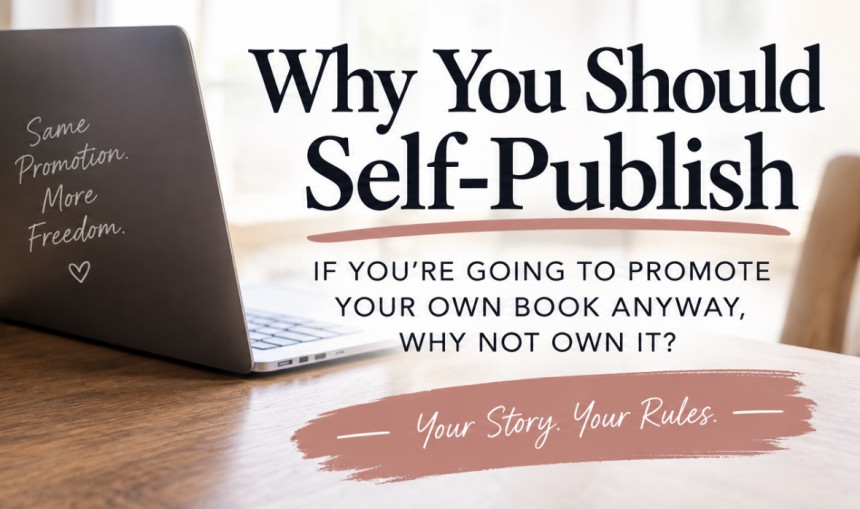

Why You Should Self-Publish
If You’re Going to Market Your Own Book Anyway, Why Not Own It?
Once upon a time, the dream was pretty straightforward.
You wrote a book. You somehow convinced a literary agent that it was a good book. They convinced a publisher that it was a good book. Then you retreated dramatically to your writing cave while an entire team of professionals handled the messy business of actually selling it.
Marketing! Publicity! Book tours! Beautiful displays at Barnes & Noble!
You were the author. Your job was to write.
That version of publishing still exists somewhere, presumably alongside affordable concert tickets and houses that cost $85,000.
For most authors?
Not so much.
The modern author is increasingly expected to be a writer, content creator, social media manager, photographer, videographer, graphic designer, salesperson, and occasionally a dancing monkey desperately pointing at floating text above their head while a trending TikTok sound plays.
And here’s the part we don’t talk about enough:
That expectation doesn’t disappear when you traditionally publish.
Which raises a fairly obvious question.
If you’re going to spend all that time selling your own book anyway… why not consider selling it yourself?
The Hermit Author Is Basically Extinct
There is something wonderfully romantic about the idea of an author disappearing into a cottage somewhere, emerging every few years with a manuscript, handing it to their publisher, and immediately vanishing again.
Unfortunately, the internet happened.
Readers don’t just follow books anymore. They follow authors.
They want your Instagram.
Your TikTok.
Your newsletter.
Your behind-the-scenes posts.
Your character aesthetics.
Your playlists.
Your writing updates.
Your reaction when the box containing your author copies arrives and you inevitably cry while opening it.
Publishing has become increasingly intertwined with personal branding, and authors who already have an audience can bring something incredibly valuable to the table: people who are ready to buy their books.
That doesn’t mean you need 500,000 TikTok followers to get traditionally published. You don’t.
But the expectation that authors participate in marketing their work is very real.
And for many writers, that’s surprising.
Your Publisher Probably Isn’t Going to Turn You Into the Next Sarah J. Maas
I think this is where the fantasy of traditional publishing and the reality of traditional publishing have become dangerously disconnected.
A lot of aspiring authors imagine getting a book deal and immediately having a marketing machine thrown behind them.
Sometimes that happens.
Publishers absolutely invest heavily in certain books. There are publicity campaigns, advance reader copies, influencer mailers, bookstore placement, advertising, events, media outreach, and all sorts of things an independent author would have difficulty arranging alone.
But publishers have a lot of books.
And they don’t have unlimited marketing budgets.
That means not every author receives the giant campaign we imagine when we picture traditional publishing.
You may still find yourself posting every day.
You may still be emailing reviewers.
You may still be begging people to preorder.
You may still be filming TikToks in your kitchen at 10:30 at night because apparently your video about morally gray fictional men needs a trending audio.
You may even decide to hire your own publicist or pay for additional marketing.
Except now you’re marketing a book whose cover you may not have chosen, whose release schedule you don’t control, and whose sale doesn’t put the majority of the retail price into your pocket.
Which is where self-publishing starts looking a little different.
Self-Publishing Isn’t the Consolation Prize Anymore
There was a time when “self-published” carried a very specific stigma.
Couldn’t get an agent?
Couldn’t get a publisher?
Fine. Upload it yourself.
But that perception is increasingly outdated.
For many authors, self-publishing isn’t Plan B.
It’s the business model.
Authors are deliberately choosing independent publishing because they want control over their books, their timelines, their branding and their careers.
And readers?
Most of them don’t care who published the book.
They care whether the cover catches their attention.
They care whether the premise sounds interesting.
They care whether someone whose opinion they trust recommended it.
They care whether BookTok has spent three weeks screaming about it.
And we’ve already watched the line between independent and traditional publishing blur.
Books can explode through self-publishing, build enormous audiences and later attract traditional publishers. Other authors remain independent because the model works for them.
The old publishing hierarchy isn’t nearly as simple as it used to be.
You Get to Keep Creative Control
This might be one of the biggest advantages of self-publishing.
That cover?
Yours.
That title?
Yours.
The release date?
Yours.
Want sprayed edges?
Go for it.
Want commissioned character art?
Do it.
Want to release three books in one year?
Godspeed.
Want to wait eighteen months because life exploded and your manuscript isn’t ready?
Nobody is threatening your publishing schedule except you.
Traditional publishing is collaborative by nature. That can be wonderful. Editors, designers, marketers and sales teams can make a book dramatically better.
But collaboration also means compromise.
Self-publishing allows an author to build exactly the product they envisioned.
Of course, there’s a catch.
You also have to pay for it.
Let’s Not Pretend Self-Publishing Is Free
This is where the “just self-publish!” conversation can get misleading.
You can upload a manuscript with almost no upfront investment.
You probably shouldn’t.
Professional editing costs money.
Cover design costs money.
Formatting may cost money.
ISBNs may cost money depending on how you’re publishing.
Advance copies cost money.
Advertising costs money.
Special editions definitely cost money.
And suddenly your cute little book has become a small business.
Because that’s what successful self-publishing really is.
You’re not simply an author anymore.
You’re the publisher.
That means the responsibilities a traditional publishing house would normally take on now belong to you.
But it also means the decisions belong to you.
And so does a much larger share of the money the book earns.
The Royalty Difference Is Hard to Ignore
Traditional publishing offers something extremely valuable: the publisher assumes the financial risk.
You’re not personally paying your editor, cover designer, printer, distributor and sales team. Depending on your contract, you may also receive an advance against future royalties.
Self-publishing flips that arrangement.
You take the financial risk.
But you also have significantly more earning potential per copy.
That doesn’t automatically mean you’ll make more money.
A smaller percentage of 100,000 traditionally published copies can obviously beat a larger percentage of 200 self-published copies.
Reach matters.
Distribution matters.
Bookstore access matters.
Discoverability matters.
But if you’ve already built an audience capable of generating meaningful sales, the math becomes much more interesting.
Especially when you realize you’re probably going to be promoting the book either way.
Social Media Changed the Equation
This is really the heart of it.
Twenty years ago, a publisher had access to something an individual author simply couldn’t replicate.
Distribution.
They had relationships with bookstores, reviewers, newspapers, magazines and media outlets.
They controlled many of the pathways between authors and readers.
Social media blew a massive hole through that wall.
An author can now speak directly to hundreds of thousands—or millions—of potential readers without asking a publisher for permission.
One TikTok can sell books.
One Instagram Reel can sell books.
One passionate reader can post a video that sends thousands of people searching for a title they’d never heard of yesterday.
Does that mean going viral is easy?
Absolutely not.
Does it mean every self-published author is going to become a bestseller?
Also absolutely not.
But authors now possess something incredibly powerful:
direct access to readers.
And once authors gained that access, the value proposition of publishing inevitably started changing.
Traditional Publishing Still Has Major Advantages
Before someone starts sharpening a pitchfork in the comments, let me be clear:
Traditional publishing is not dead.
It isn’t useless.
And self-publishing isn’t inherently better.
Traditional publishers can provide professional editing, cover design, production, distribution, industry connections, bookstore access, media opportunities and financial backing that would be incredibly difficult for an individual author to recreate.
There’s also something to be said for having a team whose entire job is helping turn your manuscript into a marketable book.
For many writers, that’s exactly what they want.
But aspiring authors should understand what traditional publishing doesn’t necessarily guarantee.
It doesn’t guarantee bestseller status.
It doesn’t guarantee a huge marketing budget.
It doesn’t guarantee your book will be stacked on a table at the front of every bookstore.
And it certainly doesn’t guarantee that you can delete Instagram, throw your phone into the ocean and spend the rest of your career mysteriously writing novels by candlelight.
You’re probably still going to have to promote the thing.
So… Why Not Self-Publish?
Maybe that’s the question aspiring authors should start asking.
Not:
“What if I can’t get traditionally published?”
But:
“Which publishing model actually makes sense for the career I want?”
If you hate marketing, self-publishing probably isn’t going to magically solve that problem.
But traditional publishing might not solve it either.
If you’re already willing to build a social media presence, interact with readers, create promotional content, develop your author brand and actively sell your books, you’re already doing a substantial part of the work required to be an indie author.
So what are you getting in exchange for handing over some of your creative control and revenue?
For some authors, the answer will be:
A lot.
Professional support. Distribution. Editorial expertise. Bookstore placement. Financial investment. Industry legitimacy and opportunities they couldn’t easily create themselves.
That’s worth it.
For other authors?
The answer might be considerably less compelling.
And that’s when self-publishing deserves serious consideration.
Maybe the Dream Has Changed
For decades, getting traditionally published was treated as the finish line.
You weren’t really an author until somebody in New York decided you were one.
But readers have changed.
Publishing has changed.
Technology has changed.
And authors have changed with it.
You can hire your own editor.
You can commission your own cover.
You can distribute your own book.
You can build your own audience.
You can create your own marketing campaign.
And yes, doing all of that is difficult.
But here’s the uncomfortable truth:
You might be doing half of it anyway.
So maybe the dream isn’t simply getting a publisher to say yes anymore.
Maybe it’s building a writing career that actually works for you.
And whether that means signing with one of the Big Five, working with a smaller independent press or becoming your own publisher entirely?
There has never been a better time for authors to realize they have options.
The hermit author may be dead.
But the independent author?
They’re just getting started.
About the Author
Ashley is a military wife and mother, who can often be found listening to an audiobook while driving the mom taxi, desperate to cling to sanity through the joy of escapism. Her love of reading inspired her return to school, and she is currently finishing her bachelor’s degree in creative writing at Southern New Hampshire University. Being a mother does not mean you have to give up your dreams, and her story is still being written.