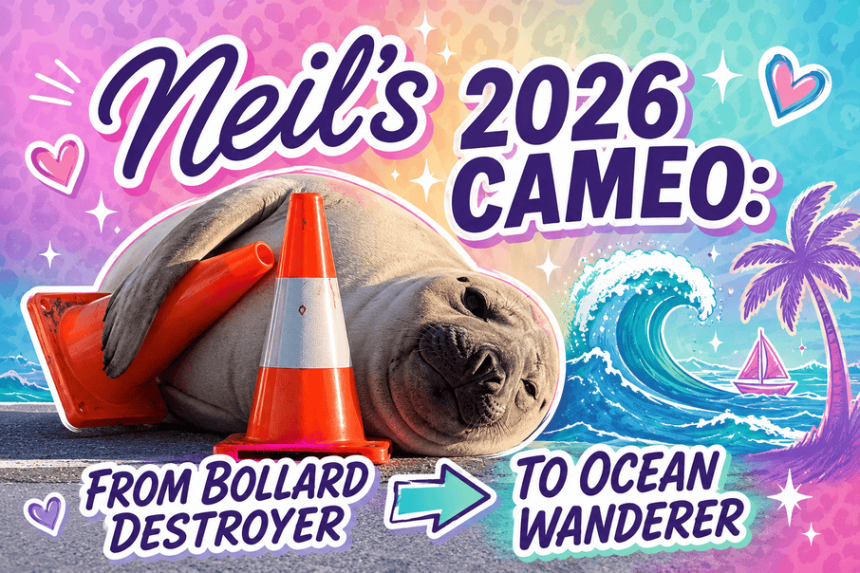

Neil’s 2026 cameo: from bollard destroyer to ocean wanderer
In late June 2026, the roughly 1,000 kg (2,200 lb) southern elephant seal returned to southern Tasmania to moult and rest, appearing around spots like Seven Mile Beach and the Tasman Peninsula. Over the next week or so, he resumed his signature antics:
- Lying across roads and forcing traffic to detour around him
- Toppling bollards, cones, and fences as if they were rude suggestions
- Leaning on parked cars and generally treating the neighborhood like his personal playground
Then, on 9 July, Tasmania’s Department of Natural Resources and Environment announced that Neil had “returned safely to the sea,” calling it expected, natural behavior. He’s gone—for now—slipping back into the ocean and leaving the traffic cones and street signs of Tasmania to breathe a small sigh of relief.
Why we love Neil: he’s the ultimate free spirit
We love Neil not just because he’s huge and oddly cute, but because he’s gloriously, unapologetically free. The world bends around him: cars stop, people rearrange their days, news crews show up, algorithms feed on his every move, and he just… keeps existing. He doesn’t ask permission, he doesn’t follow our rules, and he certainly doesn’t apologize for shredding a fence or claiming a road as his personal nap zone.
And honestly, don’t we all have days where we wish we could do the same,call in “wildlife behavior,” ignore the inbox, and just chill or dramatically destroy something small in our path? Neil is the embodiment of that fantasy: a 1‑tonne mammal living entirely on his own terms while the rest of us orbit around him.
His “destructive allure” is part of the charm. Experts say his bollard-smashing, cone-toppling, and car-bumping are normal “play-fighting” and social behaviors for a young male elephant seal, just scaled up to 1,000 kg. That tension—between danger and goofiness—is what makes him so compelling on camera. He’s not performing for us; he’s just being Neil, and the world moves around him as he lives his best life.
How creators far from Tasmania have capitalized on Neil
Neil’s fame has exploded far beyond his Tasmanian home. His TikTok following sits around 1.4 million—more than double Tasmania’s human population—fueling a global content economy he never asked to join.
Creators who live nowhere near Tasmania have capitalized on Neil in several ways:
- Compilation and reaction channels: Cutting together clips from local footage, adding commentary, music, or memes to rack up views and ad revenue.
- Short-form “cute chaos” clips: Repackaging Neil’s bollard-smashing or road-blocking moments into viral shorts and Reels optimized for engagement, often with minimal original context.
- Merch and fan accounts: Running dedicated Instagram and TikTok fan pages that monetize through sponsorships, affiliate links, or merchandise, sometimes explicitly reminding followers that Neil “is not there for our financial gain.”
- News and explainers: International outlets and creators using Neil as a recurring “feel-good wildlife” story, driving traffic and subscriptions even though they’ve never set foot in Tasmania.
The result is a kind of digital “Neil industrial complex”: content about Neil travels everywhere, while Neil himself stays put, occasionally stressed by the very attention that fuels distant creators’ algorithms.
Why Tasmania is magical for safeguarding Neil
Tasmania has become a kind of accidental sanctuary for Neil because:
- He’s a local anomaly: Southern elephant seals usually live thousands of kilometers away on subantarctic islands like Macquarie and Heard; Neil is the only male regularly hauling out in Tasmania in recent years.
- Community buy-in: Many residents treat him as a quirky neighbor, working around him instead of trying to force him out.
- Official stewardship: Rangers have fitted him with a tracker in the past to monitor movements, relocated him when crowds became unsafe, and repeatedly urged people to keep distance and not share his exact location.
- Legal protection: Disturbing protected species can bring significant penalties, giving teeth to the “give him space” message.
In that sense, Tasmania acts less like a cage and more like a community-managed buffer zone: a place where local norms, enforcement, and geography combine to let Neil be wild while limiting the worst effects of human curiosity.
Filming wildlife respectfully: what the town (and officials) got right
As Neil’s fame grows, the way locals and authorities handle filming and interaction sets a strong example:
- Keep distance: Stay at least 20 m from Neil; keep dogs 50 m away.
- Don’t block his path: Never get between Neil and the water; don’t surround or corner him.
- No feeding: He doesn’t need food and won’t eat on land; offering meals only encourages risky behavior.
- Don’t geotag or broadcast exact locations: Authorities have asked people not to share his precise whereabouts so his resting spots don’t become a circus.
- Respect signage and barriers: If rangers put up fences or cones, they’re there for both human and animal safety.
These practices matter because “loving Neil to death” is a real risk: if public behavior becomes too dangerous, wildlife officials may have to consider extreme measures, including euthanasia, for animals seen as an ongoing threat.
We still need these guidelines, because loving a wild animal means respecting his boundaries. But they’re not about dampening the fun; they’re about making sure Neil can keep doing his “live free, crush bollards” tour for years to come
Until his next visit
Neil is now back at sea, free to roam, feed, and plot his next land-based appearance. His satellite tag fell off during a previous moult and hasn’t been replaced, so he isn’t being actively tracked unless special circumstances arise. Officials say he could return to the same area or haul out nearby again, or head to feeding grounds further south.
When he does come back, enjoy the spectacle, give him space, and let yourself borrow a little of his energy: the freedom to ignore the noise, live on your own timeline, and, if needed, metaphorically (not literally) body‑slam a traffic cone or two.
Until then, Neil is out there somewhere, probably shredding kelp forests instead of bollards, reminding us that sometimes the most powerful thing you can do is just… be Neil.
Abiut the author
Nikki Lopez is a seasoned professional with over a decade of experience in the startup world, specializing in leveraging creative content and community building to empower content creators. Known for a strategic approach and a deep understanding of audience needs, Nikki has a proven track record of leading the development of engaging content strategies and guiding the growth of thriving communities. Her leadership focuses on fostering meaningful interactions and impactful journeys for both creators and their audiences.