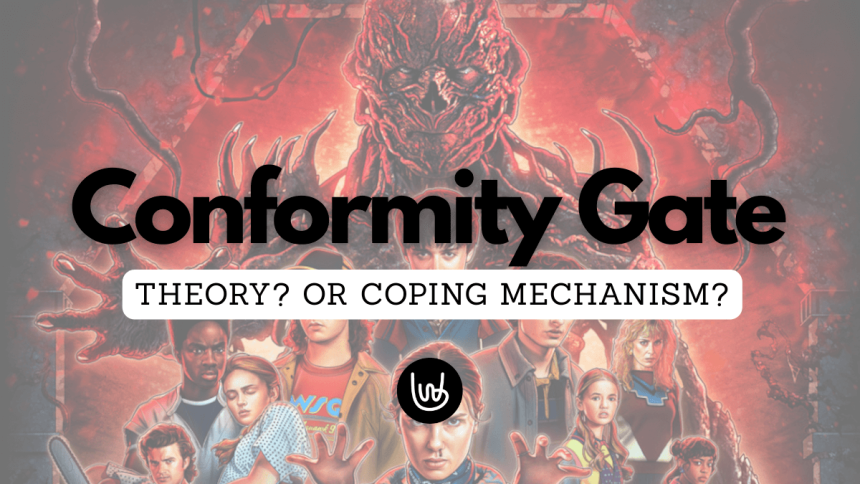

Conformity Gate: Theory? Or Coping Mechanism?
Millions of Stranger Things fans didn’t just theorize about the show’s ending; they collectively refused to accept it.
Enter Conformity Gate: a rumor so widespread, so emotionally charged, and so algorithmically amplified that it briefly felt less like a theory and more like an inevitability. TikToks broke it down. Reddit threads defended it. YouTube videos “proved” it. And for a moment, denial wasn’t just a stage of grief; it was a fandom-wide event.
Was Conformity Gate the result of millions of people experiencing denial at the same time?
Or was it something more powerful and more useful than Netflix realized?
Because love it or hate it, Conformity Gate wasn’t chaos.
It was a masterclass in how rumors work when fandom, grief, and algorithms collide.
Delusion? Or Denial?
When Stranger Things began its long goodbye, fans didn’t just speculate; they organized. What emerged wasn’t a single theory, but an entire belief system: Conformity Gate. One part rumor, one part emotional lifeline, put it together, and you get a collective coping mechanism that engulfed TikTok, Reddit, YouTube, and Discord like a tidal wave.
At first glance, Conformity Gate looked like classic fandom overreach. But reducing it to “fans being dramatic” misses the point. What happened wasn’t chaos; it was psychology, amplified by algorithms and left to grow in a narrative vacuum.
The real question isn’t whether Conformity Gate was right, whether Netflix should be taking notes. And I believe it's the latter.
What Conformity Gate Actually Was
Conformity Gate was a coping mechanism.
Fans dissected:
- Symbolism across multiple seasons
- Dialogue that suddenly felt “loaded.”
- Visual cues reframed as evidence.
At a certain point, the theory stopped being speculative and started being protective. The more people believed, the safer it felt to believe too.
Rumors at this scale don’t function as misinformation; they function as an emotional safety net.
Denial, But Make It Viral
When a story ends in a way that disrupts emotional closure, denial doesn’t stay private for long; it becomes collective. Fans aren’t just disappointed; they’re grieving something that once felt permanent. That shared sense of loss creates a vacuum, and audiences rush to fill it together.
This is where the hunger begins, not just for answers, but for content recaps, theories, alternate interpretations, anything that keeps the story alive a little longer. Watch parties reappear, podcasts dissect every frame, timelines are rewritten in threads and videos, and fan fiction offers versions of the ending that feel more survivable. What looks like an obsession is often just processing, happening in public.
Algorithms are built to notice that kind of behavior. They don’t reward quiet reflection or complicated feelings; they reward certainty, emotion, and engagement. Posts that declare “This destroyed my childhood” travel farther than ones that try to untangle why the ending hurts. Nuance moves slowly. Outrage doesn’t.
For many fans, these stories aren’t just shows; they’re pieces of lived history. They’re tied to after-school routines, family couches, late-night binges, and the first characters that ever felt like friends. When that history feels dismissed, denial becomes a form of protection. Going viral isn’t the goal; it's the result. The more people grieve together, the more content the system feeds them, and the longer denial can masquerade as discourse.
The Narrative Vacuum Netflix Left Behind
To be clear: Netflix didn’t cause Conformity Gate. Rumors are inevitable in fandom spaces (I’m looking at you, Swifties), especially around finales.
But where Netflix stumbled was in assuming silence equals neutrality.
In reality:
- Silence creates narrative vacuums
- Vacuums invite speculation
- Speculation hardens into expectation
And when expectation goes unmet, something has to step in to finish the story. In the absence of official framing, rumors don’t just circulate; they settle. They offer structure where none was provided, turning uncertainty into something that feels intentional. What looks like misinformation is often just an audience reaching for closure, and rumors become the fulfillment of a story the platform chose not to complete out loud.
Ambiuity Isn’t a Mistake. But Silence Was.
It’s worth being clear: the Stranger Things ending wasn’t a twist, and it wasn’t a failure of storytelling. The ambiguity surrounding Eleven’s fate was a deliberate, thoughtful choice, one that trusted the audience to decide for themselves whether to believe she lived or died. For many viewers, that openness wasn’t distressing; it was beautiful. But we are talking about the fans who did find it distressing.
Conformity Gate didn’t emerge because the ending was unclear. It emerged because some fans couldn’t tolerate that clarity came in the form of choice rather than confirmation.
That distinction matters.
Ambiguity invites interpretation. Conspiracy demands correction. Conformity Gate wasn’t an organic extension of the text; it was looking for deeper meaning that simply wasn’t there and turning that into belief through repetition and algorithmic reinforcement. At that point, silence wasn’t respectful. It was permissive.
Netflix should have debunked Conformity Gate quickly and directly. Not defensively, not mockingly, but clearly. A simple statement confirming that the ending was meant to stand as-is would have collapsed the theory before it could metastasize.
And if Netflix wanted to capitalize on the moment, the move wasn’t to let rumors breathe; it was to redirect attention forward. January 7 wasn’t the time to say “all episodes are now streaming.” It was time to announce what comes next. A spin-off tease. A future in the same universe. Proof that ambiguity in one story doesn’t mean abandonment of the world. And if it is not their plan to continue a new story in this world, there was nothing to be gained from allowing the rumors to snowball as they did.
Conformity Gate didn’t prove audiences can’t handle ambiguity; it proved that when clarity is absent, the loudest interpretation fills the gap.
Netflix didn’t need to feed the rumor mill.
They needed to shut it down and then provide fans with a new focus.
The Real Lesson of Conformity Gate
Conformity Gate wasn’t embarrassing. It was predictable.
When fandoms reach a certain size and exist across interconnected social platforms, rumors stop being background noise and become shared narratives. In earlier eras, reactions to major series finales stayed fragmented, small pockets of fans processing endings in isolation. Today, TikTok, Reddit, YouTube, and X collapse those pockets into a single, amplified conversation, allowing speculation to scale almost instantly.
In that environment, rumors don’t just spread; they function as collective coping mechanisms. They help people sit with uncertainty, give shape to emotional responses, and create community during moments of narrative free fall. What made Conformity Gate feel overwhelming wasn’t the theory itself, but the way modern social media allowed it to echo, reinforce, and legitimize itself across channels simultaneously.
Because in the end, Conformity Gate wasn’t fans being delusional.
It was fans being human, just very, very loud about it.
And if Netflix and other fandom-facing companies are paying attention, that amplification effect, not the rumor, is the most valuable takeaway.
What Now? The Part of the Ending Fans Don’t Like to Talk About
So here we are.
Stranger Things is really over. Conformity Gate has run its course. The theories have stopped escalating, the algorithms have moved on, and what’s left is the part no one can theorize their way out of: acceptance.
And yes, that part belongs to the fans.
Denial was natural and even inevitable at this scale, but staying there turns community into stagnation rather than celebration. Moving forward means rewatching the series without trying to fix it, channeling emotion into creative work instead of correction, making space for new stories, and recognizing that endings aren’t failures but features of meaningful storytelling. Conformity Gate proved how deeply fans cared; acceptance is how that care evolves once the noise fades and the story is allowed to rest.
About the Author
Ashley is a busy wife and mother who can often be found listening to an audiobook while driving the mom taxi in a desperate attempt to cling to her sanity through the joy of escapism. Her love of reading inspired her to return to school, and she is currently finishing her bachelor’s degree in creative writing at Southern New Hampshire University. Being a mother does not mean you have to give up your dreams; her story is still being written.