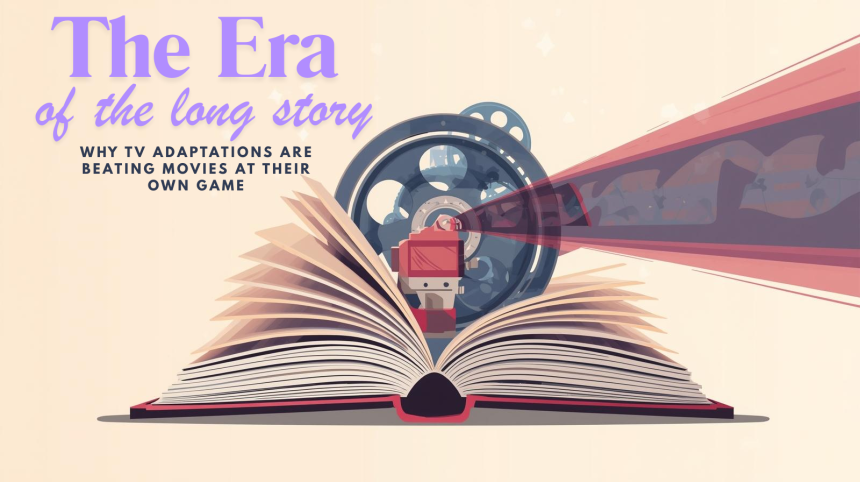

The Era of the Long Story
Why TV Adaptations are Beating Movies at Their Own Game.
There was a time when landing a movie deal was the dream.
The poster. The premiere. The two-hour cinematic event.
Now? Increasingly, the real win is a streaming series.
Over the past decade, book-to-screen adaptations haven’t slowed down, but the format that’s thriving has shifted dramatically. While film adaptations struggle to satisfy devoted readers, television series are quietly (and sometimes loudly) dominating the conversation.
So what changed?
And why does TV keep winning where movies keep falling short?
Let’s talk about it.
The Time Problem: Two Hours vs. 10 Episodes
At its core, the issue is math.
A 400-page novel simply does not fit neatly into a two-hour film. Even beloved franchises like The Hunger Games or Harry Potter and the Goblet of Fire had to compress entire character arcs, eliminate subplots, and flatten emotional beats to make runtime.
Readers notice. They always notice.
TV, on the other hand, breathes.
A series like Game of Thrones (at least in its earlier seasons) succeeded because it had space. Space for politics. Space for secondary characters. Space for quiet moments that build tension.
More recently, The Summer I Turned Pretty demonstrated how a book adaptation can linger in emotional nuance instead of racing to a third-act climax.
Books are long-form storytelling. Television is long-form storytelling.
The match makes sense.
Fandom Has Changed and It Wants Depth
The modern audience isn’t just watching. They’re theorizing, clipping scenes for TikTok, building Reddit threads, and dissecting dialogue frame by frame.
Streaming culture rewards slow burns.
When Shadow and Bone premiered, the adaptation expanded the universe in ways that invited ongoing discourse, even when fans debated those changes. That conversation extended the life of the story.
A movie drops. It trends for a weekend. It’s done.
A series unfolds weekly. Or even when it’s binge-dropped, it fuels discussion for months.
Books create communities. Series adaptations nurture them.
Character Development Is the Real Star
Some film adaptations are brilliant. Little Women worked because it leaned into structure and voice rather than trying to replicate every scene.
Dune succeeded visually, but even it required splitting one novel into multiple films to do justice to the scope.
But here’s the thing: what readers fall in love with isn’t usually plot.
It’s interiority.
It’s watching a character evolve slowly, make bad decisions, sit in complicated feelings.
Series like Normal People or Bridgerton thrive because they allow us to live with characters. We aren’t rushing toward a tidy resolution. We’re inhabiting the messy middle.
That’s a very bookish experience.
The Economics of Risk
Movies are expensive, high-pressure bets.
A film adaptation needs to open big. It has one weekend to prove itself.
If it underperforms, it’s labeled a failure, even if audiences later discover it.
Streaming platforms operate differently. A series can build momentum over weeks. It can justify its existence through subscriber retention, not just box office numbers.
This lowers the barrier for niche books to find a screen life.
A fantasy epic that might be “too risky” as a $150 million film can become an eight-episode season instead.
For authors, that changes the landscape dramatically.
The Emotional Payoff Problem
Here’s something readers don’t always articulate: movie adaptations often feel rushed at the end.
Not because the filmmakers don’t care, but because structurally, they have to accelerate.
Books build catharsis slowly. TV mirrors that pacing. Film often can’t.
When a series finale lands well, it feels earned.
When a movie tries to condense 20 chapters of emotional unraveling into 18 minutes? It feels like a highlight reel.
So Are Movies Dead?
No.
Theatrical adaptations still create cultural moments. There’s nothing like sitting in a dark theater, surrounded by strangers, experiencing a beloved story together.
But the prestige of “we got a movie deal” is no longer the only gold standard.
In many cases, a TV adaptation signals something more aligned with how readers consume stories now: episodic, immersive, communal.
What This Means for Authors
For writers, especially indie and emerging authors, this shift matters.
When pitching stories, thinking episodically isn’t just trendy. It’s strategic.
Cliffhangers.
Character arcs that unfold gradually.
World-building that sustains multiple threads.
The line between “novel” and “season one” is getting thinner.
And perhaps most importantly: readers are no longer satisfied with surface-level adaptation. They want fidelity to tone, to emotional pacing, to the experience of reading.
Television, right now, is simply better equipped to deliver that.
The Big Picture
We are living in the era of the long story.
The binge. The multi-season arc. The character we grow up with over years.
Books have always thrived in that space.
Now television does too.
Movies aren’t failing because they’re worse—they’re just built for a different rhythm. And increasingly, that rhythm doesn’t match how readers want their favorite stories retold.
The question isn’t whether adaptations will continue.
It’s whether filmmakers will keep trying to compress what readers want to expand.
About the Author
Ashley is a busy wife and mother who can often be found listening to an audiobook while driving the mom taxi in a desperate attempt to cling to her sanity through the joy of escapism. Her love of reading inspired her to return to school, and she is currently finishing her bachelor’s degree in creative writing at Southern New Hampshire University. Being a mother does not mean you have to give up your dreams; her story is still being written.